

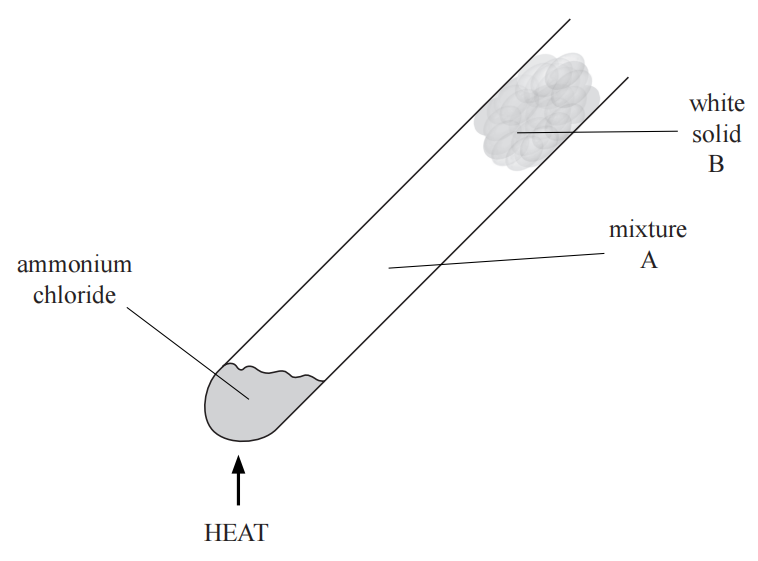
The diagram shows ammonium chloride being heated in a test tube.
(d) Place crosses (х) in two boxes to identify the processes that occur in the test tube.
📝 Detailed explanation
When ammonium chloride is heated in the test tube, it does not simply melt or boil. Instead, it undergoes thermal decomposition. This means that the solid ammonium chloride (NH4Cl) breaks down into two different gases: ammonia (NH3) and hydrogen chloride (HCl).NH4Cl (s) → NH3 (g) + HCl (g)
This is a chemical change because one compound splits into simpler substances, so the process is called decomposition.
As the hot gases rise up the cooler part of the test tube, they come into contact with each other again. Ammonia is a base and hydrogen chloride is an acid. When they react together, they form ammonium chloride again:
NH3 (g) + HCl (g) → NH4Cl (s)
This reaction between an acid (HCl) and a base (NH3) is called neutralisation. The white solid seen at the top of the test tube is ammonium chloride that has re-formed from these gases.
Therefore, the two processes that occur in the test tube are decomposition and neutralisation.